SCHOOL LIBRARY PROGRAMS
Why Do We Need School Libraries?
A curated collection, a place to learn and research and a place to simply be. Here is what none of the alternatives — a public library, a classroom library or books at home — expands to absorb when a School Library closes.
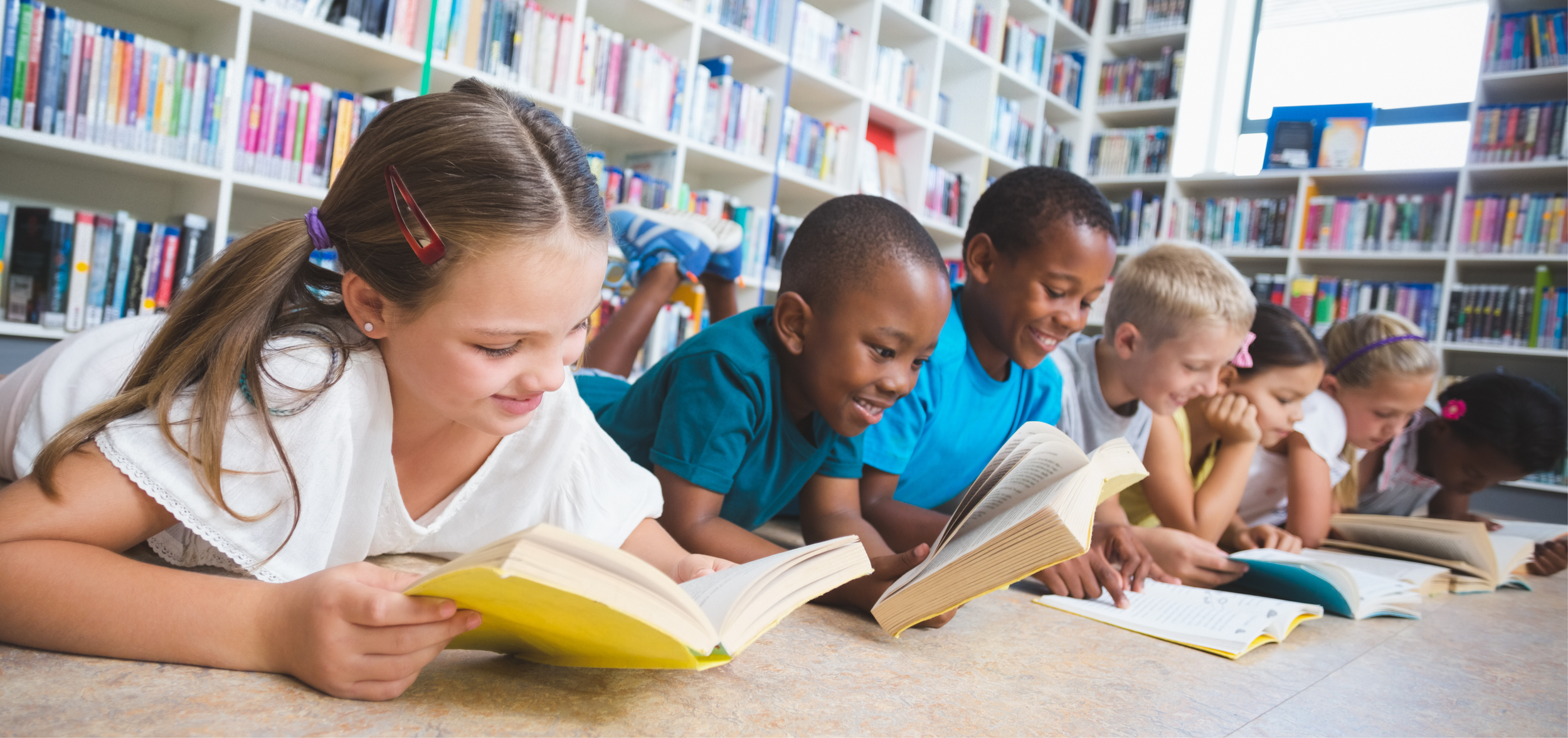
So what does a School Library actually give every child?
A place to read and find books
A current, professionally curated collection matched to the ages, reading abilities and interests of the students actually in the building — print, digital and audio, from picture books to graphic novels to research databases, plus accessible formats and materials in other languages.
A place to learn, research and make
Information literacy, research skills and digital citizenship taught directly and planned alongside classroom teachers across every subject. Subscriptions and databases students cannot get at home, makerspaces, technology and remote access from anywhere.
A place to be
A welcoming third space with reading nooks, lounge areas, collaborative tables and read-aloud corners — open before, during and after the school day. Book clubs, read-alouds, poetry nights, community reads and author visits. One of the few rooms in a school with no grade attached to it.
And it is not the same as a public, classroom or home library
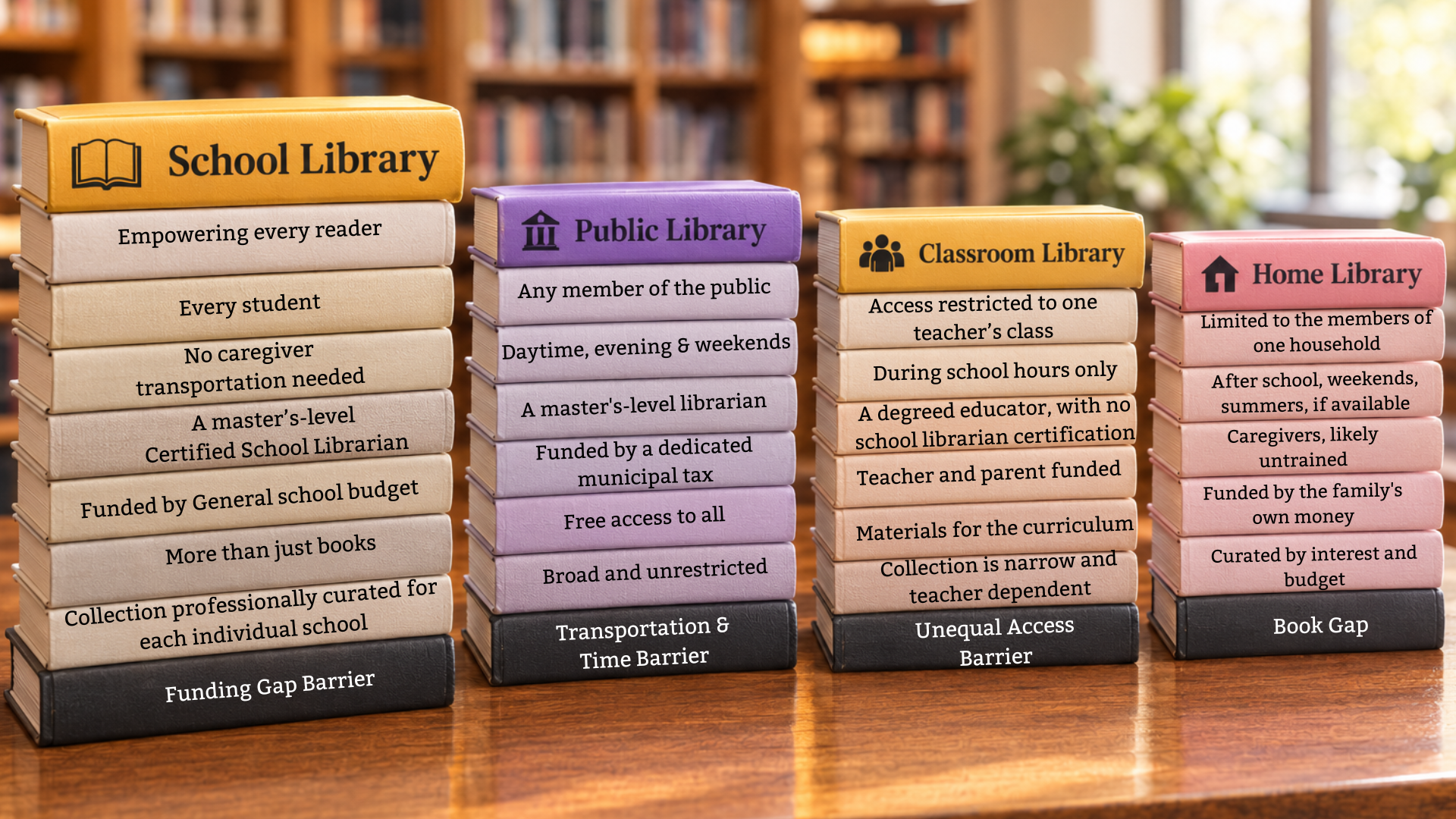
Four collections that look similar on the surface do very different jobs. Tap or click any line on the stacks below to learn more.
Tap or click any line on the book spines to learn more.
Turn your phone sideways for a bigger view.
The privilege we don't see
The alternatives to a School Library all assume something many students don't have.
Reaching a public library
Many caregivers work nights and weekends. Some families have no car or share one. Some caregivers are unfamiliar with the library, intimidated by it or face a language barrier.
A good classroom library
Funding and access vary enormously between states, districts and schools — and between classrooms in the same building, because they are often paid for by the teacher.
A home library
Books at the right reading ability and interest cost money. Caregivers working multiple jobs may have no time to read aloud. Some children are unhoused or moving between foster placements.
The School Library is the one collection every child can reach without a car, a credit card or a caregiver.
Common questions about School Libraries
The pushback you're most likely to hear about the library itself, and how to answer it.
We already have a public library nearby, so why do we need a School Library too?
Show responseHide response
A public library is a wonderful partner, but it does a different job. It serves every age in the community with a wide collection, and getting there usually takes a caregiver with time and transport. A School Library is curated for the students actually in the building and the curriculum they are taught, it is open during the school day with no ride needed, and it is run by a certified School Librarian. It is also funded very differently: public libraries have had their own municipal library tax since 1884, while School Libraries have no dedicated funding in New Jersey.
Everything is online now, so why do we need a School Librarian?
Show responseHide response
Being online all day is the problem, not the solution. The School Librarian is the counterbalance: the person who keeps print books and protected reading time in students' days, and who teaches them to find information online, judge whether it can be trusted and use it responsibly, including AI. New Jersey's information literacy law names the school library media specialist in that work, with the new standards anticipated for September 2027.
The school already has a library room, so doesn't it already have what it needs?
Show responseHide response
A library is a room; a librarian is a person; neither on its own is a service. One New Jersey district in four employs no School Librarian at all, and when the librarian goes, the room often follows.
Can't a classroom library do the same job?
Show responseHide response
A classroom library serves one teacher's class, roughly 15 to 25 students, and is open at that teacher's discretion. It is usually paid for with the teacher's own money, grants and parent donations, so what's on the shelves can differ from one classroom to the next in the same building. It tends to be narrow, built around one content area and a few reading levels, and it is run by an educator without School Librarian training, often for a single year. It's a good complement to a School Library. It can't replace one.
Can't families just build a home library?
Show responseHide response
Books at the right reading level and interest cost money, and caregivers working multiple jobs may have no time to read aloud. Some children are unhoused or moving between foster placements. A School Library closes that gap by giving every student the same collection, whatever their household can afford.
See what a program adds, grade by grade
Preschool through high school — the program looks different at every stage.
What a Program Offers Each StudentEvery figure on this page is sourced at schoolsneedlibrarians.com/sources.