School Library Programs
What Does a School Librarian Do?
The educator whose job is to build readers, and to teach every student how to find, question and use information.
The role has changed dramatically over the last 30 years. Card catalogs and date stamps have given way to research databases, digital citizenship and AI literacy. What hasn’t changed is the heart of the job: putting the right book in a child’s hands at the right time.
It matters more now than ever, because today’s students face more information, and more choices, than any generation before them.

The Counterbalance to the Tech Effect
Technology has disrupted the conditions that reading, literacy and learning depend on. School Librarians are trained to counteract this.
- 01Certified School Librarian + School Library
- 02More reading by choice + balance between print & technology
- 03Greater reading volume & higher quality reading
- 04Increase in fluency, vocabulary, comprehension & reading stamina
- 05Higher Academic Achievement + Better Mental Well-Being
A School Librarian is not just a person in a room full of books.
As master’s-level educators who are trained in learning theory and instructional design, child and young adult literacy, emerging literacies, and collection building, School Librarians can support schools as they implement the science of reading by curating books and developing literacy programs that reinforce the instruction that students receive in the classroom across all subjects.
And while the science of reading teaches students how to read, it doesn’t motivate them to read. School Librarians are key to creating programs and providing a balance of print + digital materials that get students reading in and out of school.
School Librarians also are the most qualified educator in the building to teach Information Literacy, including research skills, source evaluation, the judicious use of AI and digital citizenship.
A School Librarian reaches every student in the building across every subject, not just in the library, and their role is critical now more than ever.

The educator built for the science of reading, and for literacy as a whole
In 2024, New Jersey moved to the science of reading. The Reading Rope shows what that takes: word recognition that becomes automatic, and language comprehension that keeps growing for years. A School Librarian’s work strengthens both strands, plus the motivation that makes children want to use them.
Practice with the right books
In the early grades, School Librarians partner with classroom teachers to reinforce phonological awareness, vocabulary and comprehension strategies, and curate collections aligned with the science of reading, including decodable texts and phonics-based readers.
Practice with the right books is how decoding becomes automatic.
Wide reading across every subject
School Librarians build background knowledge, vocabulary, language structures and reasoning by getting students reading widely across subjects, genres and levels. Their read-alouds and book clubs give students the opportunity to hear rich language and discuss what they read.
They co-teach literacy with teachers in math, science, social studies and more, and build collections that meet every interest and reading level.
The reason to keep reading
The science of reading teaches students how to read. Reading for pleasure gives them a reason why: 13-year-olds who read for fun almost daily score 29 points higher on NAEP than those who never do.
School Librarians protect time for reading by choice, and match each child to books they’ll want to finish.
Beyond the early grades. New Jersey’s literacy law and framework focus on early literacy, and the State’s literacy professional development includes School Librarians alongside teachers. But middle school is when motivation becomes one of the main ways students keep building vocabulary, knowledge and stamina. A School Librarian carries the science of reading through middle and high school, in every subject.
The training behind it
Beyond a master’s degree in Library Media Studies, an NJDOE-approved School Library Media Specialist program and a year-long residency in a school library, School Librarians are trained in:
- Learning theory
- Instructional design
- Children’s and young adult literacy
- Emerging literacies
- Collection building
- Information search and technology
- Library leadership
Teaching students what information to trust, including what AI tells them
New Jersey law requires information literacy instruction in every grade, kindergarten through 12, and it names the School Librarian in developing that curriculum whenever possible. A School Librarian is the educator trained to teach it: how to find information, question it and use it well.
Judging what to trust
Students learn to search well, check who is behind a source, and judge credibility, reliability and perspective, so they can tell trustworthy information from everything else they scroll past.
This is the heart of a School Librarian’s training in information search and technology.
Using AI wisely
School Librarians teach the judicious use of AI, including how to question what it produces. New Jersey’s new standard 9.3 covers how students evaluate sources, judge credibility and use AI tools responsibly, with implementation anticipated in September 2027.
Responsible and safe online
Online safety, cyberbullying, and the ethical use and production of information, taught across every content area and planned alongside classroom teachers.
Research skills that carry through school. From a first research project in elementary school to research databases, citation tools and support for AP and IB capstone projects in high school, a School Librarian builds these skills year after year. See how this is written into New Jersey law.
What the research finds
The strongest evidence yet
It’s cause, not coincidence
For decades, studies found that schools with School Librarians had higher test scores. Skeptics could fairly ask whether those schools simply had other advantages. So in 2014, the national school library field set out to test cause rather than correlation.
A North Carolina study then followed fourth graders across four school years. Each student with a full-time certified School Librarian was matched with a similar student without one, on prior scores, disability, language and economic circumstances. In every year, in both reading and math, the students with a School Librarian scored significantly higher.
Students that had a School Librarian scored higher in…
2 subjects.
No exceptions.
60+studies across more than 24 states over 30 years find higher reading & math scores for schools with full-time certified School Librarians.
Read moreShow less
The link holds regardless of student demographics and school characteristics. A national study using NAEP fourth-grade reading scores also found the reverse: where schools lost librarians, reading scores declined or grew more slowly.
3×more likely to score Advanced on writing assessments: students in schools with a full-time certified School Librarian.
Read moreShow less
This comes from a Pennsylvania statewide study. Nearly 8% more students also scored Advanced in reading where there was a full-time certified School Librarian, and that advantage grew from elementary to middle to high school.
+10 ptshigher share of students meeting reading expectations at schools with School Librarians, in a statewide impact study.
Read moreShow less
Across these impact studies, the students who tend to benefit most are those in at-risk groups: exactly the students who are least likely to have books and a library within reach at home.
What happens when the librarians disappear?
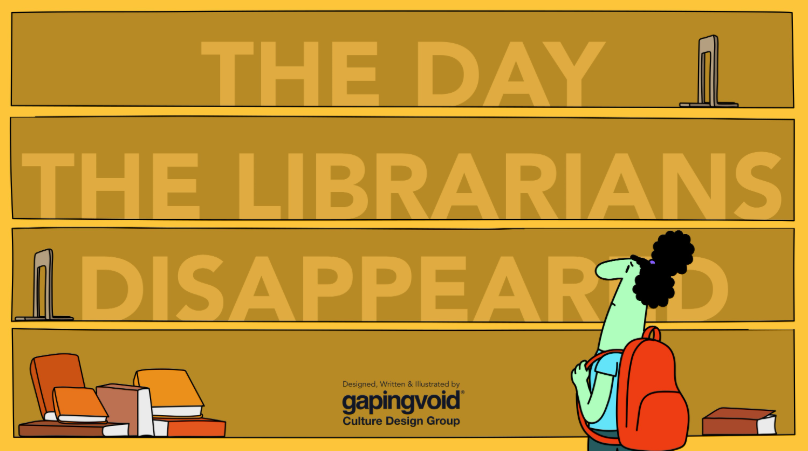
Before the numbers, here is a short story that makes the point in a few minutes. The Day the Librarians Disappeared, created by GapingVoid with the School Library System of Genesee Valley BOCES, shows what a school loses when the person at the center of its library is gone.
The Day the Librarians Disappeared by GapingVoid and the School Library System of Genesee Valley BOCES. Supported in part by the Institute of Museum and Library Services. Graphics used under a Creative Commons Attribution-NonCommercial-NoDerivatives license.
Common questions about School Librarians
Tap any question to see the answer.
“It’s nice to have, but I don’t know if a library or a librarian is necessary.”AnswerClose
A School Library Program isn’t an extra. It supports literacy instruction across every subject, teaches information literacy, including AI literacy, and fosters a love of reading, literacy and learning. It’s a critical part of a school’s educational foundation. See what a School Library Program offers each student.
New Jersey already agrees. Since 2008, the State has counted School Librarians in what it says a thorough and efficient education costs, and state code requires every school to provide library-media services under the direction of a certified school library media specialist.
Can a volunteer or an aide cover the work of a School Librarian?AnswerClose
No. A School Librarian holds a master’s degree, an instructional certificate and a year-long school residency. They teach information and AI literacy, plan lessons with teachers across the curriculum, and build a collection matched to every reading level, IEP and home language in the building.
Trained aides and volunteers are a valuable part of a strong program, but they support a School Librarian. They don’t substitute for one. See the School Librarian comparison.
If a school has a library, doesn’t that mean it has a School Librarian?AnswerClose
Not necessarily. A library is a room, and a librarian is a person; neither on its own is a service. One in four New Jersey districts employs no School Librarian at all, and when the librarian goes, the room often follows.
It’s worth asking: is there a certified School Librarian in your child’s building full time, or shared across several schools? Is the library open all day, or only when a class is scheduled? See where New Jersey stands.
With tight school budgets, can we really afford a School Librarian?AnswerClose
We can’t afford not to. Since 2008, New Jersey has built School Librarians into the base cost of a thorough and efficient education, paid for through local property taxes and state aid.
In other words, New Jersey says we’re already paying for it. The question is whether that money is reaching a School Librarian in your child’s school. See what the law says and what New Jersey already funds.
Why Do We Need School Libraries?
So why isn’t a public library, a classroom library or books at home enough?
Why do we need School Libraries?Every figure on this page is sourced at schoolsneedlibrarians.com/sources.