Since 2010 the U.S. no longer directly invests in School Libraries. The result is that thousands of school districts across the country are left without School Libraries, School Library Programs or Certified School Librarians.
In the past decade the U.S. has lost over 20% of its School Librarians and nearly 45% of School Library support staff.
Decades of disinvestment in our critical School Library Infrastructure has co-occurred with the Literacy Crisis and the unfettered use of technology & social media in schools and at home.
Schools in the U.S. need High-Quality School Library Programs to counterbalance the overuse of technology, help children & young adults navigate the AI landscape and counteract the effects of the Literacy Crisis.
“Once you learn to read, you will be forever free.” - Frederick Douglass
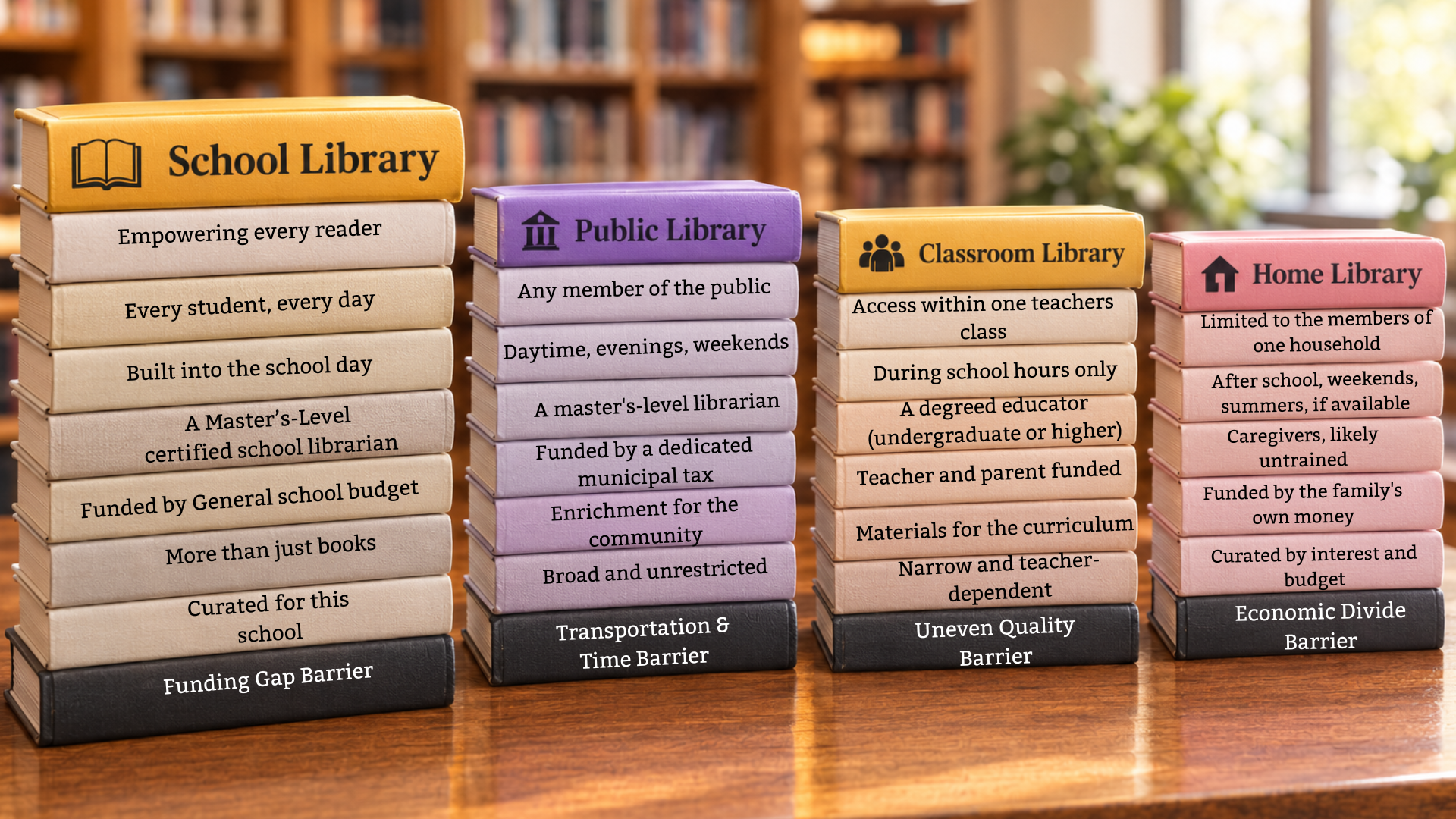
And it is not the same as a public, classroom or home library
Four collections that look similar on the surface do very different jobs. Tap or click any line on the stacks below to learn more.
Tap or click any line on the book spines to learn more.
Turn your phone sideways for a bigger view.
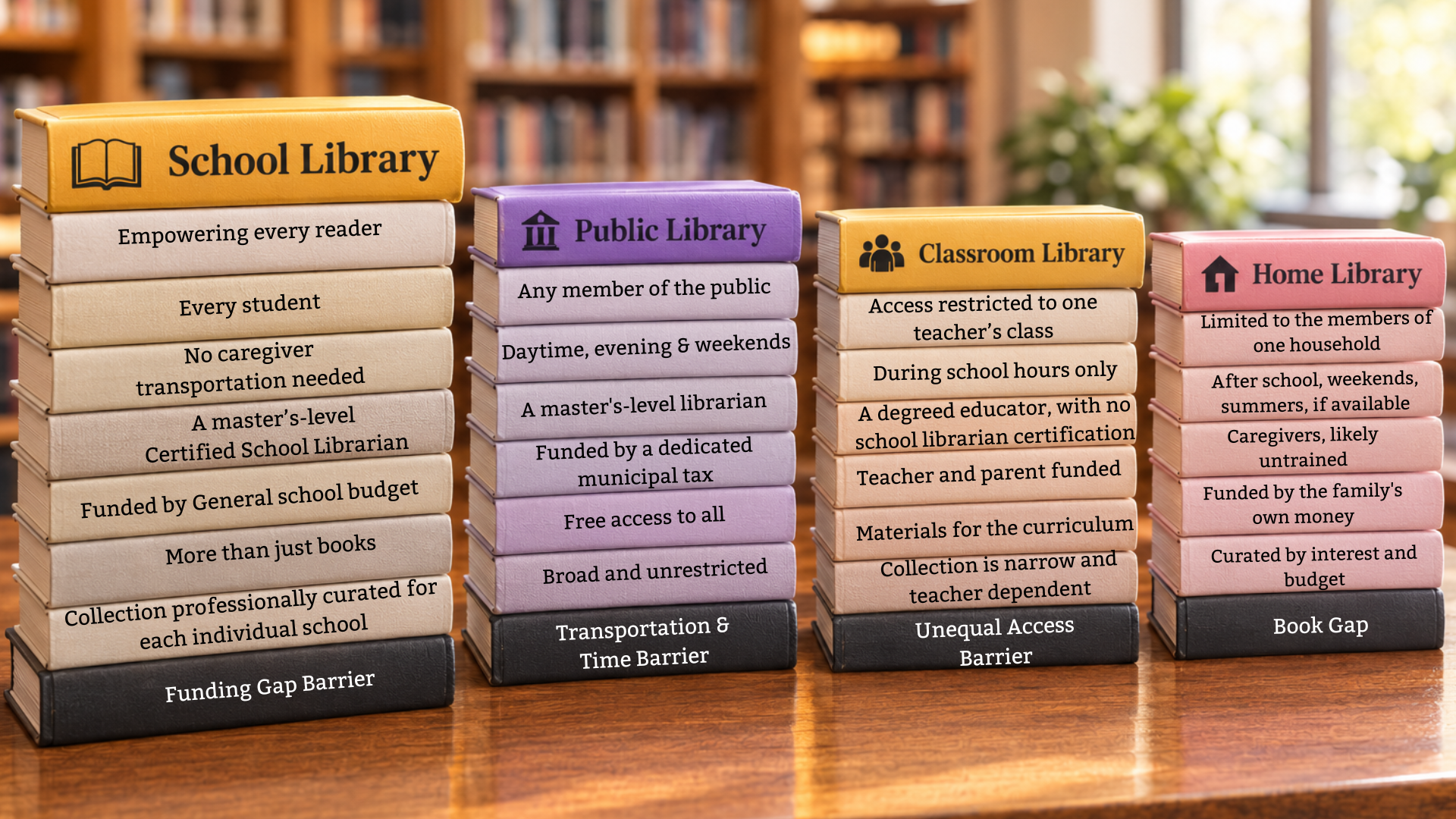
One educator supporting every grade and every subject, year after year.
A School Librarian is not just a person in a room full of books. They hold a master's degree, a state teaching certificate and a year-long school residency. They have six distinct roles in the school which include working with every student, in every grade, year after year — up to six years in an elementary school.
Their teaching reaches every subject in the building. They plan alongside classroom teachers to bring reading, research and information literacy into ELA, math, science, social studies, the arts, world languages, computer science and career readiness. That is why their work shows up across the whole school, not just in the library.
The Widening Gap
Reading for pleasure, school librarian staffing & teen smartphone ownership, 2010–2024
Points mark actual survey/data years; the dotted line has only two measured points.
New Jersey has cut more than 30% of its school librarian positions since 2011. Over the same years, 98% of 15-year-olds now own a smartphone, and districts poured much of $190bn in pandemic relief funding into classroom technology instead.
Reading: NAEP Long-Term Trend, age 13, “reads for fun almost every day,” nationsreportcard.gov. Librarians: NCES Common Core of Data, Digest of Education Statistics Table 213.10. Teen smartphone ownership: Pew Research Center surveys of U.S. teens — 23% figure is ages 12–17 (2011); 95% figure is ages 13–17 (2022–2024). NJ figures: NJASL district data; 98% teen figure: OECD PISA.
The Literacy Crisis, part 2 of 3
What Supported Literacy Looks Like
In 2024, New Jersey passed laws moving the State’s literacy instruction from balanced literacy to an evidence-based, science-backed approach: the science of reading. Here is what that approach says students need to become skilled readers.
How skilled reading is built
The science of reading rests on two well-established research models. Both agree on the core idea: understanding what you read depends on two separate sets of skills, word recognition (reading the words on the page) and language comprehension (understanding what those words mean). Where they differ is in how much detail they show.
The Simple View of Reading
Gough and Tunmer, 1986
This model treats word recognition and language comprehension as equally essential to reading comprehension. It describes their relationship as multiplication rather than addition, so strength in one can’t make up for a gap in the other.
If either one is zero, comprehension is zero. A child who can decode every word but doesn’t know what they mean won’t understand the text, and neither will a child with a rich vocabulary who can’t decode it.
The Reading Rope
Scarborough, 2001
This model takes the same two components and breaks each one into the strands that build it: three for word recognition and five for language comprehension.
With practice, the word recognition strands become automatic, so a reader no longer has to think about them. The language comprehension strands become increasingly strategic, growing with every book a child reads. Skilled reading is all eight woven tightly together.
The Simple View of Reading
Gough and Tunmer, 1986
Because it’s multiplication, if either side is zero, the answer is zero.
The Reading Rope
Scarborough, 2001
Language comprehension becomes increasingly strategic
- Background knowledge
- Vocabulary
- Language structures
- Verbal reasoning
- Literacy knowledge
Background knowledge, vocabulary, language structures, verbal reasoning and literacy knowledge equip students to analyze texts, discuss them and apply what they learn across subjects.
Word recognition becomes increasingly automatic
- Phonological awareness
- Decoding
- Sight recognition
Phonological awareness, decoding and sight recognition support automatic word recognition, so students can read more sophisticated texts with fluency.
New Jersey’s vision for English Language Arts
The State’s own standards go well beyond decoding. They describe readers who think, argue, evaluate and keep reading for life.
Foundational skills
Reading, writing, speaking and listening built as the foundation for creative and purposeful expression.
Rich, challenging texts
Reading that builds knowledge of the world, grows confidence and identity as a reader, and develops critical thinking and vocabulary.
Authentic writing
Regular, meaningful writing on valued topics, written for impact and expression and shared with others.
Evidence-based discussion
Daily writing and discussion grounded in evidence, so students read critically, build arguments and cite evidence.
Critical evaluation of media
Using complex texts and digital media to build comprehension, and judging the reliability, credibility and perspective of authors and speakers.
Communication across disciplines
Expressing ideas through many modalities and media, reading, writing and speaking purposefully in every subject.
Lifelong reading habits
Learning to persist in complex texts and reading voluntarily: for pleasure, for further education, for information on public policy and for advancement in the workplace.
The science of reading teaches students how to read. Reading for pleasure gives them a reason why.
The how
Evidence-based literacy instruction
Explicit, systematic teaching of word recognition, taught alongside the vocabulary, background knowledge and reasoning that comprehension depends on.
In New Jersey that support includes statewide professional development for teachers and other educators (including School Librarians), K–3 screening, tiered intervention and high-quality literacy instructional materials.
Without evidence-based instruction, students never build the foundation that lets them comprehend and enjoy reading.


The why
Motivation and purpose
Choice, interest and identity as a reader.
Reading for pleasure strengthens the very skills that make proficient readers, and turns instruction into a habit that lasts beyond the lesson.
NAEP weighs reading for information (non-fiction) and reading for literary experience (fiction) about 50/50 in grades 4 and 8, and 70/30 in grade 12.
The six conditions both of them depend on
Instruction and motivation only take hold when students have these. Keep them in mind: the next page shows what happened to each one.
Time and focus
A space and protected time for focused reading during school hours.
Whole books and range
Longer works in many genres, subjects, formats and levels, readily accessible.
Comprehension for developing minds is measurably better on paper, especially for informational text.
Social interaction
Read-alouds, book clubs, discussion and recommendations from adults and peers.
Truth
Current, accurate, credible information, with students doing the hard work of learning for themselves.
Guidance
Teachers trained in literacy instruction & a School Librarian. Students with a School Librarian scored higher in reading & math.
What happens when students no longer have these?
Starting around 2012, technology reshaped every one of those six conditions, while the educators who protect them were being cut.
Read the tech effectEvery figure on this page is sourced at schoolsneedlibrarians.com/sources.
The full case, in three parts
This page hits the highlights. Each part below has its own pages with the full detail.
The Literacy Crisis
Reading scores are at their lowest on record and reading for pleasure is collapsing. Here is what literacy decides, what supports it, and what technology changed.
School Library Programs
One master's-level educator, one curated collection, one welcoming room — and why a public, classroom or home library can't stand in for it.
Where New Jersey Stands
New Jersey already prices a School Librarian into every child's education. See where your district stands and what you can do about it.
A literacy crisis, not a coincidence
Nationally, 40% of fourth graders and 33% of eighth graders read below NAEP Basic — the worst in 20 years. New Jersey is no exception.
New Jersey ranks #1 in the nation for pre-K–12 education and #2 for reading, yet scores keep falling. The question isn't whether the state invests in education. It's whether it invests in the right things.
The decline began well before the pandemic. School Librarian numbers started falling steeply around 2010. By 2012, U.S. reading scores had peaked, and teen smartphone ownership had jumped from 23% to 37% in a single year. Since then, more than 20% of the nation's School Librarians have been cut. New Jersey has cut more than 30% of its own.
See how technology changed readingNew Jersey is short more than half the School Librarians it recommends
Since 2008, New Jersey has priced a certified School Librarian into what a thorough and efficient education costs. No one enforces it.
School Librarian positions short of the State's own recommendation (1,123 employed vs. 2,478 recommended)
“My school had a School Library and a School Librarian who gave me access to all the books I wanted and needed.”
— Michelle Rancic, founder, Schools Need Librarians
When the last School Librarian position disappeared from her own child's district, a Montclair parent started reading — and found it wasn't just a Montclair story.
Read Michelle's story →New Jersey is rewriting how it funds schools. This is the moment.
School Librarians are cut locally, in a single budget vote. That's where a parent has the most leverage.
Sign your district's petition
Goes straight to your own Board of Education and Superintendent.
Find your petition →Sign the statewide petition
Goes to Trenton for the four statewide asks.
Sign it →Check your district's status
Look up staffing and spending across all 535 New Jersey districts.
Look it up →Write to your legislators
Letter and email templates, plus talking points, in the Toolkit.
Open the Toolkit →Parents across the state are already connecting
Sign up for updates on where the campaign stands and what's happening in your area.
Every figure on this page is sourced at schoolsneedlibrarians.com/sources.
“We cannot say for sure, but declining levels of reading for enjoyment and the shift towards digital reading — skimming social media feeds and rapidly processing information — may be compromising the ability of students to engage with complex texts and data.”
OECD, PISA 2025 Results
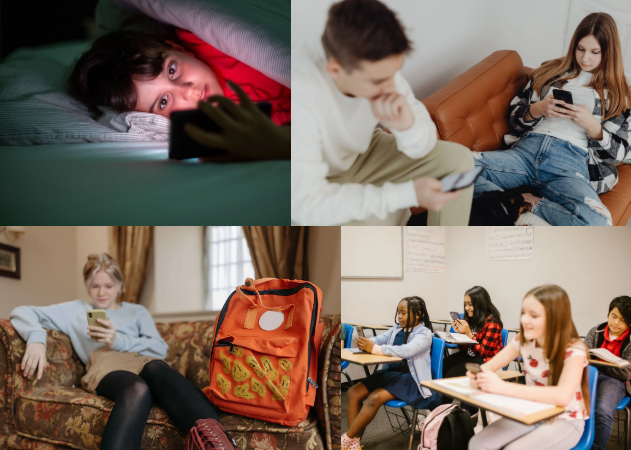
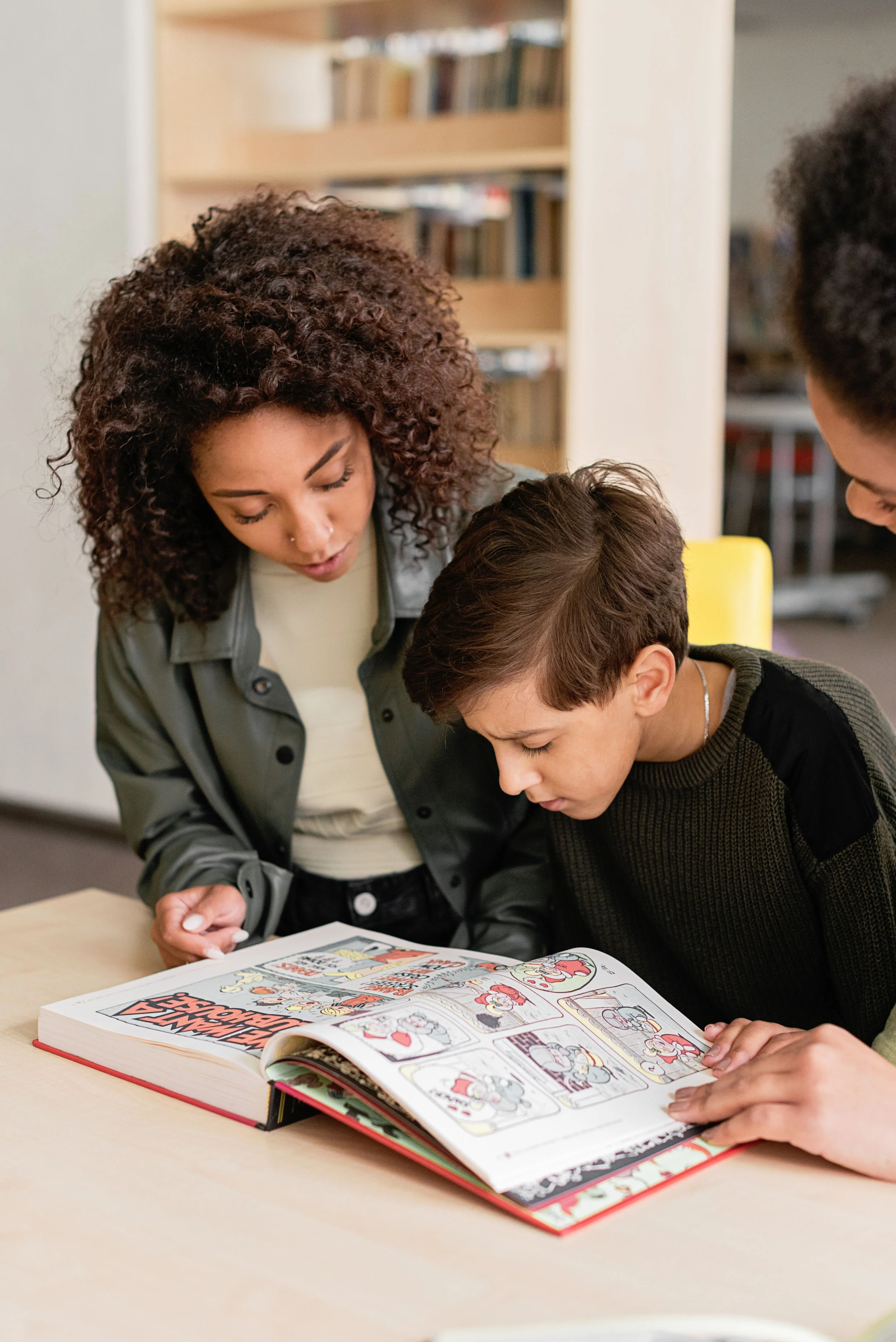
How technology disrupted reading and learning
Each step feeds the next.
- 01More smartphones, social media and EdTech
- 02Less reading for pleasure and less reading in print
- 03Less reading, and lower-quality reading
- 04Weaker fluency, vocabulary, comprehension and stamina
- 05Lower achievement and poorer mental wellbeing
What happened to the six conditions readers need
On the previous page, these were the six conditions every reader depends on. Choose one to see what technology did to it.
Time and focus
98% of 15-year-olds own a smartphone, and 59% say they’re distracted by other students’ devices. Quiet time for focused studying and reading for pleasure was replaced by social media and constant interruptions, fragmenting learning.
Fragmented attention and less time reading→weaker focus, fluency and reading stamina
Whole books and range
Feeds train students to skim, and their vocabulary is more limited than a book’s. Algorithms narrow what students see. As stamina and reading complexity fall, so does the range of vocabulary, formats, cultures and experiences students meet.
Skimming replaces sustained reading→narrower vocabulary and background knowledge
Schools reduced print budgets and moved reading and learning onto screens. Dozens of studies find students understand informational text better on paper, yet believe they understood more when reading on screens. Brain scans show why: paper readers had already pieced the story together, while tablet readers were slower and their brains had to work harder to catch up.
Less print in front of students→shallower processing, weaker attention and less retained
Social interaction
Excessive use is linked to isolation and feelings of exclusion, lost sleep, attention problems, cyberbullying and social comparison that erodes self-esteem. Above three hours a day, adolescents face double the risk of anxiety and depression symptoms. Shared reading, book clubs and discussions became parallel scrolling.
Reading stops being a shared activity→more isolation, less sleep, lower motivation to read and greater mental health strain
Truth
PISA 2025 finds over half of students may be vulnerable to misinformation, and that reading skills have fallen furthest in the areas tied to critical thinking: evaluating evidence and telling fact from opinion. Generative AI now does the work. In one EEG study, students writing with an AI assistant showed the weakest brain connectivity of any group, and 83% couldn’t quote a line of the essay they had just written.
Cognitive outsourcing and questionable sources→weaker recall, weaker reasoning and AI output accepted as fact
Guidance
The professional who connects literacy across every core subject, teaches media, information and AI literacy, and helps motivate students to read was cut just as technology took over.
The counterweight removed→every disruption above went unanswered
The scale is starting to tip back
After years of tipping toward technology, schools are now restricting phones, Chromebooks and AI. New Jersey’s bell-to-bell cell phone ban takes effect this school year, and bills to write AI instruction into the K–12 curriculum are before the Legislature.
In states that moved earlier, school library visits and book circulation jumped.
When you take the phone away, students reach for a book. But only if there’s a School Library open, with a School Librarian in it.
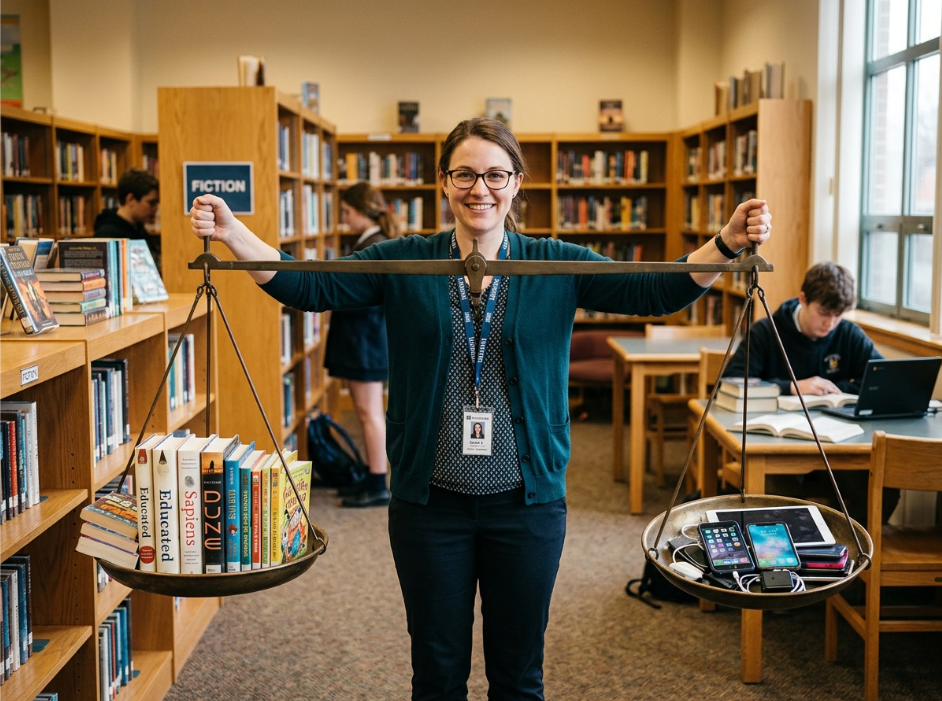
Every disruption can be counterbalanced
A high-quality School Library Program restores each of the six conditions technology took away. It starts with the person at the center of it.
What does a School Librarian do?Every figure on this page is sourced at schoolsneedlibrarians.com/sources.
And it is not the same as a public, classroom or home library
Four collections that look similar on the surface do very different jobs. Tap or click any line on the stacks below to learn more.
Tap or click any line on the book spines to learn more.
Turn your phone sideways for a bigger view.
School Library Programs
What a School Library Program Offers Each Student
One program, designed differently for every student and their specific needs. The figures below are New Jersey’s own, and they show where the gaps are. Choose a grade level or a student group to see what the program does for them.
By grade level
By student group
Preschool
#2
New Jersey has the nation’s second highest-funded preschool program.
But the gains fade, often beginning as early as third grade. A literacy-rich start has to be carried forward.
What the program offers
- A library center creating a literacy-rich environment across print, audio and digital media.
- A collection curated to align with the science of reading, including decodable texts and phonics-based readers.
- Daily read-alouds with guided discussion and follow-up activities.
- Time to browse and choose books purely for enjoyment.
- Instruction aligned from preschool through kindergarten and into elementary school.
Elementary school
47%
of New Jersey fourth graders did not meet ELA expectations.
Children not reading proficiently by the end of third grade are 4× more likely to leave school without a diploma.
What the program offers
- Partnering with teachers to integrate phonological awareness, vocabulary and comprehension strategies.
- Foundational reading supported by genuine choice.
- Learning how to use a collection, check out books and begin to research.
- Design and research skills introduced, extended and refined, then presented back to classmates.
- Reading for enjoyment protected as its own activity.
Middle school
43%
of New Jersey eighth graders did not meet ELA expectations.
Reading-for-fun figures are national (NAEP).
What the program offers
- Information literacy, including AI literacy, taught across every content area.
- Lessons in online safety and cyberbullying.
- Co-teaching literacy with content-area teachers in math, science, social studies and other subjects.
- Large, high-interest collections (graphic novels, fiction, nonfiction, series) that meet adolescents where their interests are.
- Real choice in what they read, and a safe space.
- Space designed for adolescents: lounge areas, a genuine third space, a learning commons.
- Book clubs, poetry nights, community reads — programming that makes reading social exactly when peers start to matter most.
New Jersey’s 2024 literacy law and Literacy Framework focus on early literacy. But middle school is when motivation to read becomes one of the main ways students build vocabulary, background knowledge, comprehension and stamina.
High school
50%
of New Jersey ninth graders did not meet ELA expectations.
What the program offers
- Formal goals for college and career research readiness.
- Research databases, citation tools and support for AP and IB capstone projects.
- Co-teaching literacy with content-area teachers in math, science, social studies and other subjects.
- Instruction in information literacy, AI literacy, digital citizenship and online safety.
- Lounge areas and a real third space: somewhere to be that is neither a classroom nor a phone.
- Book clubs, poetry nights, community reads — belonging, at the age when belonging matters most.
- Dedicated screen-free time and space, built around reading rather than around a device.
It shows up in college. In a six-college New Jersey study, not one first-year student from a high school with a strong, librarian-led library program rated themselves unprepared for college research.
Economically disadvantaged students
61% of families living in high poverty have no books at all at home.
What the program offers
- Summer reading programs.
- Fair book fairs and book giveaways that close the home-library gap directly.
- Extended hours before and after school, on weekends and over the summer.
- Automatic public library access.
- Technology and device borrowing.
- Districtwide common collections, so every school in a district has the same core books.
- Late and replacement fees limited or eliminated.
- A library of things and a personal care zone.
Special education students
New Jersey ranks among the top states for special education spending, and 46th on a composite measure of how well students with disabilities are actually served.
What the program offers
- Instruction aligned directly to IEP goals, planned with special education teachers.
- Collaboration with teachers, interventionists, Child Study Teams and classroom aides to understand unique needs.
- Lesson adaptations (Plans A-E) to respond to changing behaviors, learning styles and engagement levels.
- Accessible formats: audiobooks, e-books, large print, braille and e-braille, graphic, high-interest low-reading-level, speech-to-text.
- Assistive technology built into the collection rather than bolted on.
- Sensory-aware space: natural light where possible, dimmable lighting, preferential seating, self-regulation tools available to everyone.
- Communication directed to the child rather than the adult beside them.
- Never inferring reading level from age or grade — asking what they last read and liked.
- Programming designed so students can participate as they are: moving, holding something, stimming, a parent present.
- Encouragement to volunteer and outreach to students who are homebound.
Multilingual learners
Multilingual learners are about 12% of New Jersey’s student population.
What the program offers
- Dual-language collections, including at book fairs.
- Signage and family communication in multiple languages.
- High-interest, lower-reading-level titles that build confidence while English is still developing.
- Easy readers on age-appropriate topics and tied to the curriculum.
- Scaffolded read-alouds that clarify instructions and build background knowledge and vocabulary.
- Interactive story time and heavy use of visuals.
- Culturally responsive programming: multilingual story times and family literacy nights in home languages.
- Instruction planned jointly with ESL teachers.
Gifted and talented students
2021
New Jersey’s Strengthening Gifted and Talented Education Act requires services.
It is an obligation most districts must meet without dedicated funding.
What the program offers
- Collections that are advanced but still age-appropriate, a distinction that takes professional judgment.
- Academic databases and subscriptions beyond the standard curriculum.
- Specialized makerspace equipment.
- Competitions matched to interest and level, and mentorship across grade levels.
One program.
Eight populations.
One professional.
This is why a School Library is not just a room with books in it. Removing the School Librarian removes the service for every group on this page at once.
Every figure on this page is sourced at schoolsneedlibrarians.com/sources.